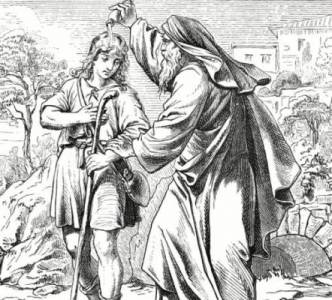
1. The First Book of Samuel
Formerly in Israel, if a man went to inquire of God, he would say, "Come, let us go to the seer," because the prophet of today used to be called a seer.
(1 Samuel 9:9)
1 Samuel 9:9 (above) pleads right away that the five books of Moses were written in the era of "prophets" because said books never use the word "seer" whereas they do use the word "prophet" fourteen times (Genesis 20:7, Exodus 7:1, 12:6, Deuteronomy 13:1-5, 18:15-22, 34:10).
Since Samuel was the first "prophet" after Moses (1 Samuel 3:20) the logical conclusion to be drawn from 1 Samuel 9:9 is that the five books of Moses were written in the days of Samuel or afterwards.
Since the books of Moses were written in the era of "prophets" the omission of the intervening centuries (Judges 2:7-10 to 1 Samuel 9:9) can only be explained in one of two ways: either the memory of the voluminous books of Moses, presumably written down in his day or in Joshua's, was transmitted orally from generation to generation within the bounds of a tiny anonymous circle of Israelites or the voluminous books of Moses were written from scratch in the era of prophets.
Hannah's song (1 Samuel 2:1-10) favours the second hypothesis hands down because its ten verses mimic the Book of Psalms.
- "My heart rejoices in the Lord" resembles "Then my soul will rejoice in the Lord" (Psalm 35:9) or "Let the righteous rejoice in the Lord" (Psalm 64:10).
- "In the Lord my horn is lifted high" resembles "the horns of the righteous will be lifted up" (Psalm 75:10) or "You have exalted my horn like that of a wild ox" (Psalm 92:10).
- "There is no Rock like our God" resembles "And who is the Rock except our God?" (Psalm 18:31).
- "She who was barren has borne seven children, but she who has had many sons pines away" resembles "He settles the barren woman in her home as a happy mother of children" (Psalm 113:9).
- "He raises the poor from the dust and lifts the needy from the ash heap" is identical to Psalm 113:7.
- "He seats them with princes and has them inherit a throne of honor" resembles "he seats them with princes, with the princes of their people" (Psalm 113:8).
- "For the foundations of the earth are the Lord's; upon them he has set the world" resembles "He set the earth on its foundations; it can never be moved" (Psalm 104:5).
- "It is not by strength that one prevails" resembles "No warrior escapes by his great strength" (Psalm 33:16).
The compelling conclusion is that a psalmist conceived Hannah's song.